Student Photography: Excel at Amherst College

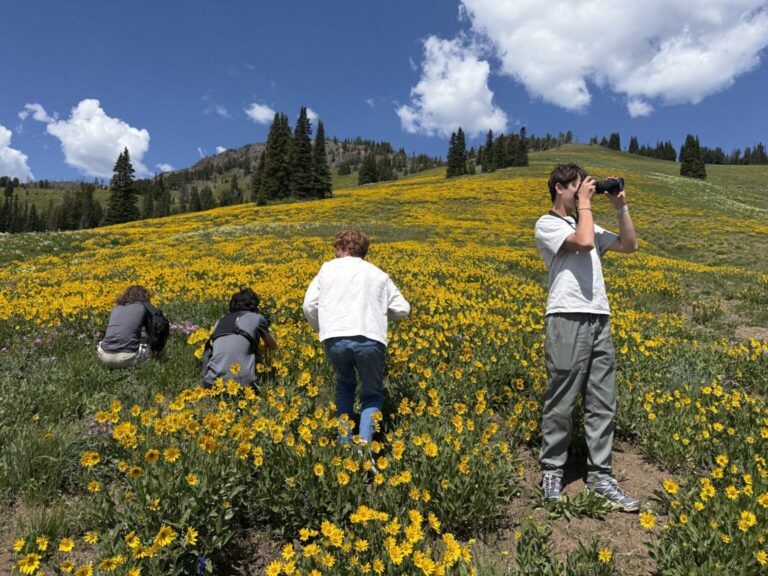
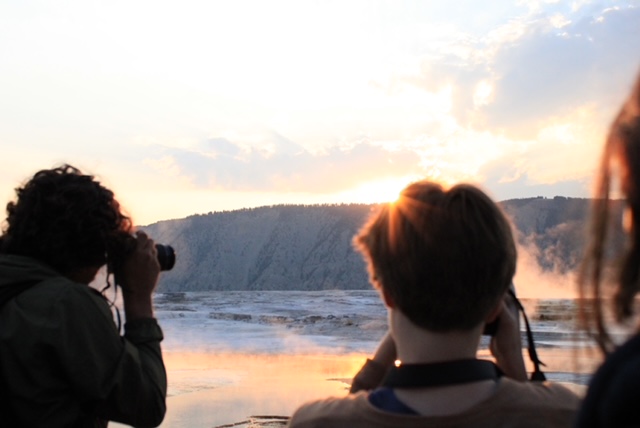
Our Excel programs in ChinaAmherstMadrid/Barcelona, and Oxford/Tuscany feature travel photography seminars. Check out this photo slideshow of 2011 student photography from Excel at Amherst College and read statements from the photographers themselves.

Posted in Excel, Excel at Amherst College, Uncategorized | Tagged , , , , | Leave a comment

Notes from Programming: Kelsey in the DR

Kelsey Burns in the Dominican Republic

Associate Director Kelsey Burns headed down to the Dominican Republic this winter to meet with local contacts and firm up plans for our 2012 Community Service program for 8th and 9th graders spent in a small town on the Southwest of the island. Read on as Kelsey introduces the Dominicans who make the program possible, and reflects on the rich history of collaboration between Putney and the small towns in the region of Barahona. Also, check out the slideshow of Community Service Dominican Republic photos from years past with captions from students who have participated. 
On the drive from Santo Domingo to Barahona, the breeze was as fresh as could be. With my windows down, I could hear bachata, merengue, salsa, and reggaeton from store fronts. The music mixed with the sounds of cars, gua-guas, and the laughter of a friendly culture. I took in the gorgeous views of the crystal clear waters of the Caribbean on my left and the fern like-tufts of the sugarcane plants swaying in the wind to my right. It had been five years since my last visit to the island of Hispaniola, when I co-led Putney’s Community Service Dominican Republic program. We had an amazing group of students that year and enjoyed each and every moment of our month in the small Dominican community of Pescadería. Now returning in 2012, I was eager to reunite with old friends, meet new community contacts, and see how things had changed.

From left, our Dominican contacts Licet, Rolando, and Putney Director Kelsey

I traveled to Barahona to meet with our local contact, Rolando Matos. Rolando has worked with Putney groups since 1999, our first year in the Dominican Republic. He and his wife, Licet, have welcomed us with open arms and have been invaluable to the success of our programs over the years. Community-minded professionals, Rolando works with a risk assessment team, evaluating how nearby communities prepare and respond to natural disasters. Rolando has strong ties to communities in the entire region and has helped us build relationships with nearby towns. Licet is a school psychologist with connections to many schools in the area. Together they are the perfect couple to help us reach communities in need.

2012 marks our thirteenth year in the Dominican Republic, and we have made significant contributions in many communities in the area. Putney groups have joined together with Dominicans to build cement foundations for families living with dirt floors, a kitchen for a community center where many community events are held, and a basketball court for a local elementary school. We’ve built a backstop for a baseball field and organized a baseball tournament as a fundraiser for the local baseball team. We’ve taught English, participated in the planting and harvesting of local crops, and lent a hand on many other projects.
During my recent trip, I was able to visit three communities with whom we have worked over the years. I met with members of the Grupo Juventil in a small town who have worked with our groups throughout the years. We spoke about how wonderful the experience has been for their community – having the chance to spend time with a group of Putney students who are interested in learning about their culture.  The projects we were able to finish during our time were important, but what stays with many of the community members is the friendship that is shared while living and working together as one community.

Spending time with Rolando and Licet was like walking down a memory lane of history between Putney Student Travel and the Dominican Republic. The two have been an integral part of everything that we have been able to accomplish here. They have volunteered their time as people who care about the communities around them. Without their support and expertise, our programs here would not have the infrastructure that makes them so special. They truly are part of the Putney family.

Posted in Community Service, Dominican Republic | Tagged , , , , | Leave a comment

The Starboard Sea: Excel Instructor’s Acclaimed Novel

Amber Dermont

Amber Dermont, a veteran leader and creative writing teacher on our Excel at Amherst CollegeExcel Oxford/Tuscany, and Excel at Bennington College programs, recently released her first novel. The Starboard Sea - a coming-of-age tale set at an elite New England boarding school – explores themes of privilege, prestige, and the quest to navigate one’s own morality. It also deals artfully in the language and metaphor of sailing. Published about a month ago, the novel has already received tremendous praise and publicity.

Amber’s debut earned her the front page of the New York Time’s Sunday Book Review, and has provoked parallels drawn between her novel and Catcher in the Rye, The Great Gatsby, and even mentioned alongside The Adventures of Huckleberry Finn and Moby Dick. The New York Times writes, “The Starboard Sea is a novel about the exhilarating freedom of being young and in love with the world, in harmony with nature and with an irreplaceable friend.”

The Starboard Sea, Amber's first novel

The New York Times reviewer describes in particular the richness of Amber’s literary take on the sea and sailing.  She writes, “Dermont’s prose glides across the ocean, reminding us why writers are so reliably drawn to the water — its beauty and its danger, and the inherent adventure every voyage contains as the boat navigates between the two… It doesn’t matter if you don’t know a spindrift from a seaboard — the language of sailing is lovely, both simple and elaborate, unexpectedly sexy and inexhaustibly metaphorical.”

The novel was also reviewed and featured by The Washington Post, The Huffington Post, Books of the Times, and Goodreads and has now spent two consecutive weeks on the Bestseller List on NPR.

We had the great privilege of catching up with Amber and talking with her a bit about her experience teaching Creative Writing seminars on our Excel Pre-College enrichment programs. An excellent example of the caliber of leaders that shape our summer experiences, she gave great insight into the value of summer writing workshops and the rewards of participating in a Putney program.

First off, congratulations on all of the positive buzz that your first novel has generated. Has it changed your day-to-day life so far?

Thank you so much! I’m grateful that readers are finding the novel and responding to it so positively. I’m especially touched by all of the letters and emails I’ve received from readers. It’s amazing how willing people are to reach out and share their responses to The Starboard Sea. It’s more than I could have hoped for. In terms of changing my day-to-day life, I find myself a little busier these days but in the best possible way with readings and book club discussions. I still have all of the responsibilities of being a college professor and writing my own stories. My office is messier than I’d like it to be.

Can you talk a little bit about your experience as a staff member on Putney programs, particularly as a creative writing instructor on our Excel programs?

I loved teaching for Putney. I was very lucky to teach four different subjects in three different programs: Bennington, Oxford/Tuscany and Amherst. At Bennington, I taught a class on Gender Studies and I still stay in touch with a number of students from that summer—one actually wound up majoring in Women’s Studies in college. In Oxford/Tuscany, I taught Creative Writing and Travel Writing. It was a real treat to be able to take the students to so many literary landmarks. I remember leading an Alice in Wonderland tour through the Oxford campus and bringing the students to The Eagle and Child, the very pub where C.S. Lewis and J. R. R. Tolkien would meet every week to discuss their writing. In Paris, the students and I lunched at Café de Flore in the same spot where Hemingway and Picasso used to dine together and argue about Modernism. When we went to Florence, we read Mary McCarthy’s love letter to that city, The Stones of Florence, and the students wrote their own travel diaries modeled off of McCarthy’s work. At Amherst, I taught Creative Writing and Screenwriting but I also served as Assistant Director of the program. It was fun to come to know the students in a different capacity.  One student mentioned to me in passing that his uncle was a sculptor and I realized that I knew his uncle’s work and that there was great piece of his on display at Mass MOCA. As Assistant Director, I was able to arrange a trip there for the entire program and it was rewarding to see the student take in his uncle’s art work for the first time.

What is your overarching philosophy as a creative writing teacher for Putney? What sort of exercises do you do with your students?

I found that the students were game for anything and willing to push the boundaries of their imaginations. I often give students triggers to help them begin a piece. Sometimes the triggers have very strict boundaries and forms. Other times, I might ask the students to model their writing after another author we’ve read. No matter the instructions, I always encourage the students to make the assignments their own and to use the assignments as a means of finding their own voice. If they merely fulfill the exercise, all they’ve done is complete an exercise. If they go off on their own into surprising, uncharted territory, then they’ve begun to take the steps toward telling a story and becoming a writer.

Can you think back on any particularly memorable students, stories, or moments from your Excel summers? What stands out the most in your mind?

One of my students from the Oxford/Tuscany trip, Harry Almquist, visited me in Houston when I was teaching at Rice University and stayed with me during his college visit. Harry is one of the smartest students I’ve ever encountered. He wound up going to the University of Chicago and is currently working in investment banking.

Another student from my screenwriting class at Amherst, Danny Gilberg, recently sent me the following email, “Thanks to you, I spent my college years at Vassar and absolutely loved it. It allowed me to grow tremendously as an individual and I learned a tremendous amount. I ended up majoring in History, and spent a lot of my time doing theater at Vassar. I did a good amount of acting and production management, but also spent one semester as director and in one other, wrote a twenty-minute play that was performed as a part of series alongside two other plays. I graduated in 2010 spent the last year working for an organization that does after-school programming in inner city schools, and orchestrated a performing arts program at my school for the second half of the year. I don’t know if you remember, but I looked at Vassar at your suggestion, and wouldn’t have ended up there without your help.”

I really appreciate the opportunity I had to work with students at such an impressionable and important moment in their lives and am especially glad that I was able to make recommendations about college and working in the arts.

Have your experiences on Putney programs had an effect on your writing? 

Yes! The title story in my short story collection, Damage Control, (forthcoming from St. Martin’s Press) is based on a comment a student made to me at Bennington during our Gender Studies class. The student in question was very smart and thoughtful but she was also struggling with some of the ideas being put forth in the class regarding feminism and equality. During one class, I brought in an old etiquette book—I’m fascinated by Miss Manners and Emily Post—and the student in question told a story about how she’d gone to an etiquette school. As she described her experiences there, she commented on the facts that while the girls paid tuition to go to the school, the boys were paid to attend. The boys were compensated for talking to the girls and attending teas. Apparently, the boys were valued for their ability to teach the girls how to flirt and make small talk. When my student heard herself tell this story, her whole view on feminism changed in an instant. I used her realization as an inspiration for my own etiquette school story, “Damage Control.”

What kind of an effect can displacement from one’s comfort zone, be it geographically or socially, have on an individual’s writing? How has this been displayed in the Putney programs on which you’ve taught?

That’s a great question! On the Oxford Tuscany trip, I had the students in the Travel Writing Class write letters to themselves at the beginning of the trip. The students wrote down everything they were looking forward to and everything they were afraid of experiencing. I collected the letters, kept them during the trip and then at the end of the class, I returned the letters to the students and they read them aloud. All of them had grown and matured so much in those weeks. All of them had faced some fear about traveling, being away from home, meeting new people and making friends in unfamiliar surroundings. I was so proud of them but more importantly, they all learned something valuable about their strengths and confidence.

Were you a writer in your high school days? What sort of things helped you find your narrative voice?

I’ve been serious about writing my whole life. My parents are rare book dealers and they constantly encouraged me to read beyond my own experiences. I never want to write the same story twice, so I’m always searching for my character’s own unique voice. The great thing about spending times with teenagers is that they have such a fresh command over language and vernacular. My novel, The Starboard Sea, is set in a prep school and I often write about teenagers. I love teaching and listening to the innovative ways my students approach language.

What sort of advice do you have for students getting excited for their creative writing seminars this summer on their Putney Excel programs?

Be really open and eager to learn from your teachers and your classmates. The students who attend Putney programs are incredibly bright and sophisticated. You will probably make a lifelong friend and find a lifelong reader for your work. When I was teaching at Putney, I was amazed by the great Tim Weed’s ability to select faculty. So many talented writers have taught for Putney—from National Book Award finalist, Salvatore Scibona to best-selling novelist, Karen Russell, to the brilliant memoirist and political satirist Periel Aschenbrand, the award-winning poet, Michael Dumanis and the historian Dominic Tierney. The faculty will support you in every way possible and will be there for you long after the program has ended.

Amber is a graduate of the Iowa Writer’s Workshop and holds a Ph.D. in Literature and Creative Writing from the University of Houston, an M.A. from Emerson College and a B.A. from Vassar College. She teaches Creative Writing at Agnes Scott College in Decatur, Georgia.

Posted in Excel, Excel at Amherst College, Oxford/Tuscany, Uncategorized | Tagged , , , , | Leave a comment

Featured Leader: Mike Schwebel

Mike in Costa Rica, 2011

We recently caught up with returning Putney leader Mike Schwebel. A Ph.D. student in Geography and Urban Studies at Temple University, Mike studies and teaches sustainability and environmental planning. He and co-leader Lily Chestnut led our Community Service Costa Rica program last summer, and he will be leading our Community Service Dominican Republic program for 8th and 9th graders this year.  Read on as Mike talks about his work, his Putney experience, and his ambitious 50 state marathon goal. Click here to read Mike’s full bio.

First things first, we here at The Barn just got wind of your impressive time on the marathon you recently ran in Washington, D.C. Can you tell us a little bit about that?

Thanks! Well, I started on a goal a few years back to run a half-marathon or marathon in every state. I had only run one full marathon previous to this one, so I thought, why not?  I spent the last four months training outside here in Philly (luckily, we had a mild winter). I ran between 27 and 37 miles a week and tried to improve my time. My ultimate goal was to break 3.5 hours and have a sub-8 minute mile split, and lo’ and behold after a few months of training, I finished the D.C. Marathon in 3 hours, 29 minutes and 2 seconds, with my pace of just under 7:59/mile.

Outside of running marathons, what have you been up to lately in your professional and academic life?

When I’m not wearing out my Asics, I spend way too much time at Temple University where I’m a Ph.D. student and Teaching Assistant in the Geography and Urban Studies Department. Broadly, I study and teach about sustainability, globalization, environmental planning, and the like. My specific research interests at the moment are small island states and their responses to forecasted climate change and overall climate change policy.

Community Service Costa Rica duo Mike and Lily, 2011

You have previously volunteered, studied, and worked extensively in Central America. What first sparked your interest in that region?

Wow, that’s a good question and something I haven’t thought about in a long time. About seven years ago, I graduated from Penn State and won a scholarship to go anywhere in the world and learn more about something related to landscape architecture. I had minored in Spanish and had never been to Central America, so I used the scholarship to live for a few months in Costa Rica, Nicaragua, and Panama – where I studied ecotourism and its practices. It was an eye-opening trip and I still keep in touch with some friends today that I met down there!

What past experiences led you to Putney Student Travel and how has your work with Putney contributed to your focus on sustainable development and urban studies?

One of the professors that I assisted at Temple was a Putney Student Travel leader herself back in the 1990s; she told me about Putney and the great experience she had as a leader.  My re-exposure and introduction to Cuajiniquil and the Tico communities we visited as a Putney group last summer was a reminder to me about not only the disparity of development between the United States and other countries – but also of the large amount of resources that we as Americans consume in comparison to the rest of the world.  

Mike and some of our local Tico contacts in Costa Rica, 2011.

Can you describe your experience leading Putney’s Community Service Costa Rica program last summer? What did you get out of the program and what stands out most in your mind?

Overall, the experience was intriguing and beneficial to both our students and us as leaders. We got to share our knowledge and understanding of Costa Rica with the participants while they were able to learn about the community, make new friends, and learn about themselves in an environment that was totally out of their comfort zone. What stands out for me is the coming together of the group. In three short weeks, the participants and the community not only became happily linked, but the physical fruits of our labor were also present in the town and hopefully will be there for many years to come. 

You will be headed out on our Community Service Dominican Republic program this summer. What are your hopes for this new experience?

Although I’ve explored much of Central America, the Dominican Republic will be a new area for me, and I hope to be able to explore and get to know the country as well as our students on the trip with my future co-leader.  My goal is to lead a group that is very dedicated to effecting positive change through their actions in the Community Service program in the Dominican Republic, while also learning about the culture, making new friends, and discovering new things about ourselves.

Do you have any advice for Putney students preparing for their first summer experience of this nature?

My advice would be to take advantage of this once-in-a-lifetime opportunity to live in a foreign country for a month.  Get to know the language, meet new people, try activities and foods you normally wouldn’t, and be willing to stay off the grid for a while.  Sometimes, the best way to experience a new place is to let go of your tether to your home, wherever that may be.  Keeping in touch with mom and dad is ok with an email every now and then, but this is a time to grow and become comfortable with your new Putney family for a few weeks – so that you have every opportunity to thrive.

Posted in Uncategorized | Tagged , , , , , , | Leave a comment

Featured Leader: John Linsley and Mount Kilimanjaro

John Linsley will be leading our Cultural Exploration Mount Kilimanjaro program

We are excited to announce that John Linsley, a four time Putney veteran, will be leading our 2012 Cultural Exploration Mount Kilimanjaro program! John is an alumnus of St. Lawrence University and the St. Lawrence Kenya Semester Program. He also holds an M.A. in International Relations from the Maxwell School of Syracuse University and has studied the Swahili language in Tanzania as a Fulbright Hays scholar. An EMT for twelve years, John has been a volunteer member of a rescue squad and is trained in wilderness emergency medicine. He has climbed the Tanzanian volcano, Oldoinyo Lengai, and has twice summited Mt. Kenya, Africa’s second highest peak. Read on as John talks a bit about what excites him most about this Cultural Exploration program.

My first experience in Tanzania was as a college student and I am still struck by the country’s varied landscapes and the diversity of its people and cultures. When I learned that Putney was launching the Cultural Exploration Kilimanjaro program this summer, I figured there was no better way to spend the summer than in Tanzania with a group of Putney students climbing Africa’s highest peak, working together on a community service project, and going on safari. I’m excited for the program to start and the opportunity to introduce this group of students to what is a fascinating country.

This program is unique because we immerse ourselves in both the natural environment and day-to-day life of Tanzania. During the service component we live in an agricultural community and work alongside local residents on a community supported project. We walk through bustling markets, interact with local school children, and learn about village government. On safari we of course get up close with wildlife, but also travel with Maasai guides and learn about their pastoralist way of life.

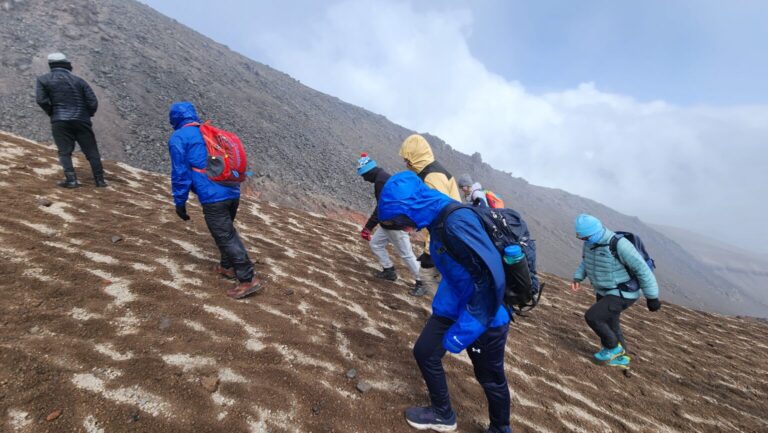
On Kilimanjaro, we travel through five different climate zones. On the mountain’s lower slopes we pass plantations full of bananas and local farmers tending the coffee crop. These agricultural lands give way to thick forest inhabited by monkeys, birds, and other wildlife. From the forest we find ourselves in cooler and less humid moorland with lots of wildflowers, and if we are lucky we may see some wildlife here too. At about 13,000 feet the moorland ends and we enter the alpine desert. This is a desolate place dotted with moss and grass. The sun is powerful during the day and the temperatures are cold at night. The final stop is the arctic zone where we pass close to some of Kilimanjaro’s remaining glaciers and make our summit attempt of the 19,340 ft. Uhuru Peak.

The program is sure to push its participants in many ways. For some that push may be physical and for others it may be emotional, intellectual or all of the above. We are sure to have a whole lot of fun!

Posted in Africa, Community Service, Cultural Exploration, Kilimanjaro, Tanzania, Uncategorized | Tagged , , , , | Leave a comment

The Language Barrier: A College Essay by Sarah

Sarah Kaufman, Tanzania 2009

Sarah Kaufman is a three time Putney Student Travel alumna. She began in 2009 with a summer of community service in Tanzania. She continued with Community Service Vietnam in 2010 and finished with our Global Awareness in Action program in Cambodia after her senior year of high school. Now a freshman at Oberlin College, Sarah got back in touch and sent us her personal statement from the college application process. This thoughtful narrative from her original Putney program in Tanzania explores the challenges of communicating without a common language.

Famous philosopher Ludwig Wittgenstein once said, “The limits of my language mean the limits of my world.” During my travels worldwide, I, too, have found myself limited in my own use of language. At times, I have felt helpless in my inability to communicate. Other times, however, I have enjoyed the language barrier before me and used it to learn more about that culture and myself.

Two summers ago, I was in Tanzania on a community service program, where my ability to speak with others was extremely limited. One day, we took a break from our service projects to participate in a day-long home stay. I was placed with two girls from my trip in a home with a family that spoke absolutely no English. Equipped with a small English-Swahili language guide and our partial knowledge of Swahili from classes we had taken, we began the day anxious about our ability to express ourselves to the mother, the father, and the three daughters. During the ten-minute walk to the house, it was obvious that the mother wanted to learn more about us, but did not know how best to communicate her curiosity. She would say something to us; we would understand one word in the sentence, look at each other, and laugh nervously.

Sarah working at the village school, Tanzania 2009

The mother understood that we could not comprehend what she was telling us, and she tried harder by using hand gestures and words that we knew. Eventually, she asked us what our names were and we were able to respond. Unfortunately, she had trouble remembering our names, and chose to call the three of us by the one name she actually did remember: Jessica. At first, we thought she was only asking Jessica to help out with the cooking and harvesting, but we soon realized that she was referring to all of us, so we tried our best to switch off with the chores. Even though I was a little frustrated that she could not remember my name, I appreciated the effort the mother put into interacting with me. I also cannot complain much, as I do not remember her name either.

Throughout the day, I found myself making an equal effort to communicate with the mother in a way that she could understand me. I used the little Swahili I knew to form broken sentences. At times, I searched frantically through our English-Swahili phrasebook in order to ask her questions. I grew more aware of what hand motions I was using, knowing that the mother could interpret them any way she wanted to. The more time I spent with the mother, the easier it became to communicate with her. I no longer laughed nervously with the two other girls from my trip. We all loosened up and began to have fun.

About halfway through the day, after we had helped the mother cook lunch and the father make bricks to sell, we were brought to the mother’s cousin’s house. She had studied English in school and was almost fluent. At that moment, I realized that I had completely forgotten that we had not been speaking English to the mother and her three daughters back at their house. The mother and I had gotten used to the each other’s gestures and the handful of words that we each understood. Upon meeting her cousin Sara, I realized I had more fun communicating with the mother than speaking English with her cousin. This came as a complete surprise to me. I had not realized how effortlessly I found a common language with the mother. I was pleased and satisfied with both myself and the mother.

Sarah working alongside a Tanzanian friend

Speaking to Sara was like being back inAmerica, having an everyday conversation with a friend. There was no excitement in our interactions, and I found my time at the cousin’s house boring and usual. Breaking the language barrier was a challenge presented to me, and I had managed to achieve our goal, only again to be placed in a situation where there was no barrier at all. The removal of this challenge disappointed me, and the fun of the day quickly faded. After leaving the English-speaking cousin, we seemed to have more difficulty communicating with the mother again. We helped her cook dinner and played with her daughters, but after the meal was eaten, we all sat in silence. It seemed that there was nothing else we could talk about and none of us wanted to put forth the effort to translate. I wanted to go back to how it was earlier in the day, when we effortlessly signaled to each other in different languages. But the cousin created a barricade between us and the mother, one that we could not seem to break. We had so much trouble communicating that it was time to go home that we had to hand them the Swahili phrase book and point to the sentence that read “I have to go.” We ended up being the last group back to our house because we had no way of letting the mother and father know that our time was up.

Since that day, I am no longer worried if I cannot speak the same language as someone else. I know I can figure out a way to break the language barrier and still have fun. I enjoy the challenge and have discovered this quality within myself in many other situations; I don’t enjoy the easy way out, and I challenge myself everyday, whether I’m writing an essay, painting a detailed picture, or playing a hard trumpet piece. Ludwig Wittgenstein’s quotation describes the times when I feel helpless, or there has been a disturbance in the flow of my communication, like when we met the mother’s English-speaking cousin. However, Wittgenstein did not understand my commitment and that I could not limit myself when it came to communication. If there is a language barrier, I will always build myself a ladder and hop on over it.

Posted in Africa, Community Service, Tanzania, Uncategorized | Tagged , , , , , | Leave a comment

The Ride Home: A College Essay by Ben Shapiro

Ben and the children who now live in the house the group constructed.

Ben Shapiro has spent two summers with Putney Student Travel. He was a member of our Excel at Amherst College program in 2010, and he traveled to Southeast Asia with Putney in 2011 as a member of our Community Service Vietnam program. Currently a senior at The John Cooper School in The Woodlands, Texas, Ben has successfully completed the college application process. He chose to write his personal statement on a a particularly pivotal moment on the service site in Vietnam this past summer. His essay reflects on compassion, privilege, and resourcefulness. Ben was accepted Early Admission to University of Richmond, where he will enroll in the fall.

After a day of work on the compassion house in the village of Tinh Hoa among the Vietnamese workers, villagers and their children, I began to pack up my water bottle, sunscreen and bug spray for the bike ride home. The locals were all talking and smoking as they squatted on the sand by the site. As they said goodbye to us, the child who would receive the house gave me some berries and reiterated some of the English the other members of my Putney Community Service program and I had taught him. I got on my bike and rode down the dirt path to the worksite on which we had come early that morning.

The compassion house built by Ben and his group.

On the way back to our guesthouse, I reflected on my first workday in all of its difficulties, how I had been so hot and miserable at times, and I realized that the people who live in this village live very simple yet tough lives. However, they somehow weren’t sad or fed up and didn’t complain even the least bit. As I rode by numerous houses, the children would enthusiastically shout “hello,” which was probably the only English word they knew. I felt like a celebrity strolling down the red carpet. People on scooters dashed by, some carrying three or four people, some carrying way too much cargo. These people probably had to save for a whole year or more to buy these vehicles, but they definitely used them to their fullest potential. All along that road, people outside their houses were making the most out of their scarce resources, whether that was chopping up trees for kindling or saving any metal for making tools. This way of life genuinely made me ponder how I should take advantage of the bountiful resources given to me. My private education and stable household had never seemed like such a privilege as they did at this moment. I didn’t reach my destination before twice being suddenly bombarded by the stench of an unrestricted trash heap and the smell of rotten fish as I crossed a bridge over a rice paddy. The seemingly boring suburb of Houston that I call home now seemed refreshing. However, when I rode past the smell, I looked out at the vast green field and the lush mountains beyond as the sun set, wishing I could climb to the top and meet the sun.

As I came into the main part of town and my destination came into view, I wondered how a mere bike ride had such an effect on me. I saw the innkeeper with his family welcoming us back into his modest yet comfortable inn. Putting my bike up, I knew I would donate that bike to a young boy in need at the end of my month there. I came to better respect life and understand how privileged my life truly is on this bike ride back from our worksite.

Posted in Community Service, Uncategorized, Vietnam | Tagged , , , , , | 1 Comment

How to Travel: A College Essay by Julia Gordon

Julia, left, will be attending Bates College.

Julia Gordon is a senior at The Archer School for Girls in Santa Monica, California, and an alumna of both Community Service Ghana and Community Service Vietnam. Like most high school seniors, Julia recently finished the rigorous process of applying to college. Below is her personal statement, a reflective narrative that illuminates her experience in Vietnam with Putney last summer. Her writing sheds new light on the quest to explore a new place as a traveler, not a tourist. This essay, along with the rest of her outstanding application, earned Julia early admission to Bates College.  Congratulations Julia!

I had to mark tourism as my reason for going to Vietnam when applying for my visa.

Julia, center, and fellow Community Service Vietnam students get to know the Vietnamese families who will benefit from their project.

Co Huong, our local Vietnamese coffee shop, was only a few houses down and across the street from the guest house–a 30 minute bike ride away from the house we were helping to construct . We would bike past it every day on our way from the guesthouse to the work site. Everyone in Vietnam rides a bike, so we rode bikes. After work we would walk over and sit down. “Seven Café Sua’s,” we would say, holding up the number seven with our hands. But we called them Café Soda, we didn’t know the difference. We sat on the wicker chairs. In a circle, we drank the free tea that tasted like wheat and relaxed. We would tell stories about Auggie, and in return hear them about Anh or Raisin, the old lady at the worksite; we would tell stories about the pigs’ blood Jell-o we ate at the death anniversary; we would learn new Vietnamese phrases; we would watch Vietnamese television while comparing who dropped more cement when attempting to plaster the compassion houses.

Julia, right, with fellow Community Service Vietnam students at work on a compassion house.

One afternoon, while sipping the delicious coffee and condensed milk mixture, we noticed the toddler-aged son of the owner. He sat in a chair far too large for him. He had a bowl in his left hand, chopsticks in the other. While staring at us with his large brown eyes, he picked up a clump of rice with the chopsticks and put most of it in his mouth, some pieces sticking to the side of his face; we marveled at a two-year-old’s ability to use chopsticks so well. I thought back to that day in Saigon at lunchtime. My first meal. I watched my fresh spring roll fall pathetically from the crooked, crossed chopsticks in my hand. I could not eat. The next night at dinner my mango salad stayed between my chopsticks a few seconds longer every bite. One month later, we stopped to eat lunch in Da Nang before we boarded a flight to Hanoi. Plates were clattering; stories were being exchanged as usual. I heard “Isn’t it funny how even though they give us forks, we still use chopsticks?” Bewildered, I looked at the fork next to my plate, and the piece of beef in between two sticks held in my right hand. The Vietnamese eat with chopsticks, so I ate with chopsticks.

For one month I was Vietnamese. I was not a tourist; I was a traveler.

Posted in Community Service, Uncategorized, Vietnam | Tagged , , , , | Leave a comment

Global Citizens: A College Essay by Shea Clark-Tieche

Shea in Vietnam, 2009

Shea Clark-Tieche has participated in community service programs in both Vietnam and Ghana. During his senior year at Windward School in Los Angeles, California, he wrote his college essay on his quest to become a ‘global citizen.’  Shea’s essay explores the questions of why we travel, how we communicate, and how our experiences shape us. This essay, along with the rest of his stellar application, earned Shea admission to Tufts University, where he is currently a freshman.

Many people don’t understand why I fly halfway across the world and throw myself into new (and often uncomfortable) situations every opportunity I get.  Everyone has their theories, some truer than others.  But whether you are my friends who think I go to France to meet girls, my parents who I think I can’t stand to be at home with them, or my grandma who thinks I have a death wish, you’re wrong. I travel for the same reason I go to school every day: to learn.  Pushing pencils behind a desk can teach a person only so much; at a certain point, you have to jump in and experience life yourself.

Shea carries precious cargo on the site of a compassionate house, Vietnam.

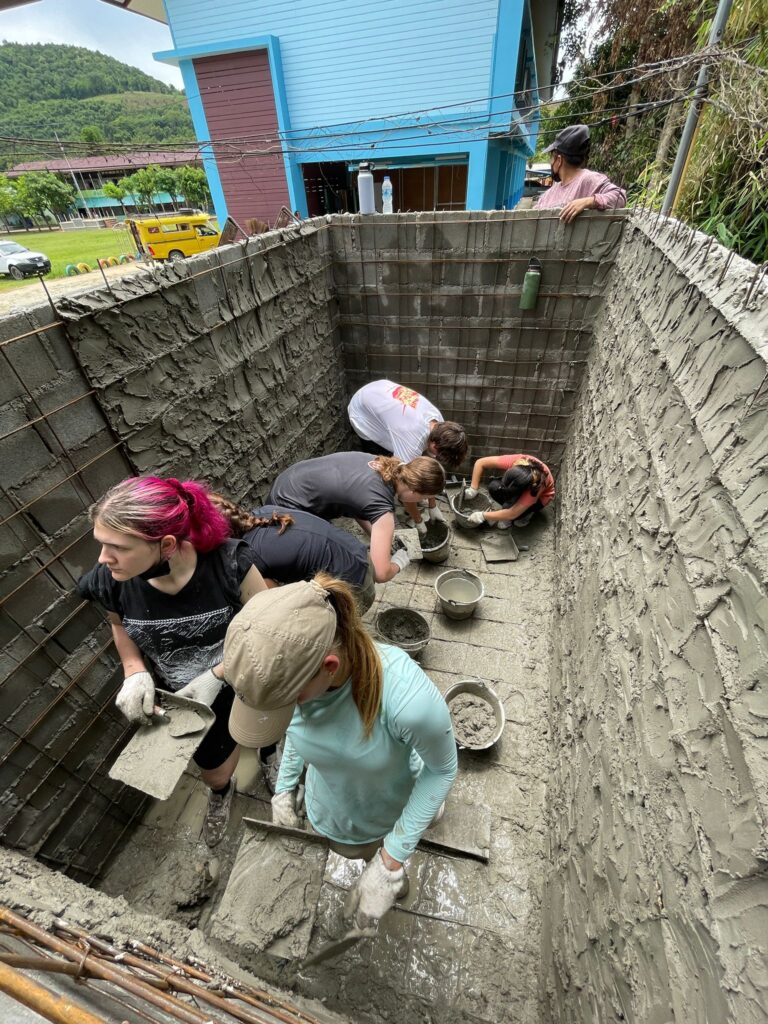
The heat was oppressive. We were in rural Vietnam, near Da Nang, to build a house for a single mother and her daughter. The empty patch of land before us looked daunting. Could this become a house? I had never before wielded a shovel!

  Two nights later and 8,000 miles from home, sitting in a circle with eighteen peers under the starry night, my group reflected on our high and low point of the day. Mine was simple:  Getting off work a little early, and curious about the local area, we biked a few kilometers through a sea of green down the road to the nearby monument. Sweat dripped from every pore. An elderly Vietnamese woman was hunched over picking weeds, painstakingly clearing them from the monument. She would have gone unnoticed to the careless passerby. But we wondered who she was.

Our leader, acting as an interpreter, relayed her story, but only managed to get out a few words before tears streamed down her face. This frail woman, Ms. Nguyen, was one of a very few survivors of the My Lai massacre. Only fragments reached my ears: alone, fear, pray, beg, luck. The broken story I was able to piece together hit me hard. But what truly touched me most was what came next.

Shea in Vietnam, 2009

One at a time, Ms. Nguyen shook our hands. When my turn came, I clutched her bony hand and looked deep into her eyes.  On the surface, I could see the pain and suffering of her hard life.  For a moment, I got as close as I ever will to being able to imagine what she went through.  Yet, past all the suffering and in the frail, but powerful grip of her hand, I could see, perhaps, forgiveness. Her story was too brutal for us to hear in whole.  Her life had been destroyed by Americans, yet she was able to put that behind her and somehow welcome us. This woman’s capacity for forgiveness shook me. Meeting Ms. Nguyen was my high and low.  She put into perspective my petty grievances and grudges, and put a human face on war – past and present. She stood in front of me as evidence of America’s misguided foreign policy. While preparing for my trip to Vietnam I had been able to peruse the Internet and history books; nothing in books could have given me that experience.

Four weeks later, near the end of my stay, I stood with another small woman clutching me: Mrs. Chi, the single mother. Together we looked at the sky blue house that now filled a plot of land that before had been nothing but shrubs and dirt.  We had worked side by side, from foundation to rooftop. Although I could never speak directly with Mrs. Chi or the local workers, that did not mean we did not communicate. We talked through our smiles, through our hands, through the food, and through our sweat.  I felt her joy and mine as we embraced.  I’m not sure who was happier. In the house, I saw the relationships, memories, and lessons I will carry with me forever.

This summer I again found myself hauling dirt, this time to build a library in rural Ghana. It was difficult at first to live without running water or electricity, but I came to love African bucket showers. As a traveler, I had come here to learn. My classrooms were the tomato fields in which I planted, the drum hut in which I danced, the local school in which I taught, the village house in which I slept, the soccer pitch on which I ran, and the slave castle through which I walked.Shea, top left, with a fellow Putney student and the children from the service village in Ghana.

Shea, top left, with a fellow Putney student and the children from the service village in Ghana.

Ghana is a rare example of a successful democracy on the African continent. July Fourth we decided to share our festivities with the Ghanaians who had gained their own independence from England only fifty years earlier. Our heads were bent low as a prayer was said. The goat struggled, desperately trying to get free. The young Ghanaian brought the machete down; the silver blade gleamed under the sun, and the life drained from the goat. The American onlookers huddled together in horror, yet excitement pulsated through the Ghanaians. Most of us Americans had never before seen something die. After we ate the roasted goat, admittedly hard for some of us, it was our turn. Around a blazing bonfire, we showed our friends how delicious a burnt marshmallow between two cookies and chocolate could taste. This was as foreign to them as killing a goat was to us. Our night in the village ended with the bonding of shared customs and a Ghanaian handshake: slap, slide, snap.

I leave something and take something from all of my travels. I believe each experience makes me a more diverse, curious, and (I hope) empathetic person. Even if I spent the rest of my life traveling, I would leave this world having only scratched the surface of what there is to learn. This notion excites me and pushes me to explore. I aspire to be a global citizen: someone who understands the lives of others and can feel at home anywhere in the world.

Posted in Community Service, Ghana, Uncategorized, Vietnam | Tagged , , , , , , | 2 Comments

Touchstone: A College Essay by Annie Ristuccia

Annie in Tanzania, 2010

Annie Ristuccia is a four time Putney alumna. She has participated in Community Service programs in Tanzania, Ecuador, Ghana, and Vietnam. Annie has worked on a variety of projects and made connections with local people in small villages all over the world. Now a freshman studying Public Health at New York University, Annie recently shared an essay with us that she submitted during the college application process last year. The piece details a particularly powerful experience Annie had in Tanzania during her summer of community service there.

“You – I’m sorry, what was your name? I want to tell you something.” Pete points to the middle of the crowd of students seated in front of him.

“Me?” I stammer, as the room falls silent, everyone looking my way.  “I’m Annie.”

“Yes, you! Annie, I’ve taken a lot of public speaking classes, and they always tell you to find a touchstone in the crowd. Someone engaged and empathetic, to whom you can always look back. You’re my touchstone; you’re always smiling and listening.”

He was right; I certainly felt intrigued by what he had to say. Pete O’Neal, a former Black Panther and political exile, moved to Tanzania nearly 40 years ago with his wife Charlotte.  They have cofounded the United African Alliance Community Center where they warmly welcomed us.  Our group of thirteen students lived in a small village outside of Arusha, Tanzania for the month of July with a program sometimes referred to as “Seeds For Progress”.  Our purpose was to construct part of the local primary school.  On a break, it was exciting to explore the small world Pete and Charlotte had created from nothing.  The surrounding walls were covered top to bottom in vivid murals that each had their own significance.  Martin Luther King, Jr., Malcom X, and phrases like “Karibuni Sana”, which means, “All are Very Welcome”, created an inviting and warm atmosphere throughout the grounds.  Bright wildflower gardens, a large tire swing, and a free roaming horse added playful touches.  The family dog even had dreads!

Annie reads a story to the schoolchildren in her community service village.

The UAACC began as a place to celebrate unique African culture in 1991.  This mission was hard to miss when we found ourselves thrown into a dance workshop minutes after stepping off the bus.  We stumbled nervously and tried to get away with lip-synching Swahili as we practiced a fully choreographed routine.  Standing between two instructors, I soon went from stepping on toes and butchering the beautiful language, to moving with the beat of the drums and realizing that the lyrics told a story of a man who bought an eleven dollar fish to bring to his greedy wife for dinner.  It was particularly important to find my place in the performance, since we were expected to entertain a crowd later that afternoon.  I was eager to discover what else was waiting within these walls.  I found the art room and the music studio, which were filled with original creations by visitors, teachers, students, children, or anyone else who felt the spark.  Round, open classrooms sat next door, where anyone could come to learn English or computer skills or even HIV/AIDS prevention, and our group spent a few hours discussing current events and everyday struggles with young locals.  The potable water supply was a remarkable addition for everyone in the surrounding town.  It was uncommon for families living in the rural outskirts of Arusha to enjoy confidence in their water but here there was no worry about its source and its quality.  Finally, we found ourselves in front of the orphanage, painted in radiant hues of yellow, blue and green, with budding flowers to decorate the outline.  Above the door were the words, “Leaders of Tomorrow Children’s Home”.  Twenty smiling faces charged outside to greet us, and my heart warmed to some of the most positive, playful, and outgoing children I have ever met.  Someone was holding my hand for every second of the weekend as we all danced, played basketball and tag, sang popular songs, and modeled our silliest facial expressions for the camera.

I felt a seed begin to grow within me that day, when Pete spotlighted me.  Now it’s time for my passion to flourish, wherever it may take me.  One thing is sure.  I’ll know I’ve succeeded when I find myself standing before the leaders of tomorrow, having found my voice; when I am the one showing what has been accomplished.  I’ll be the one inspiring my own touchstone in the crowd.

Posted in Africa, Community Service, Tanzania, Uncategorized | Tagged , , , | Leave a comment